


Outdoor wall art makes a commitment that a potted plant or an outdoor chair never has to. It is fixed, visible every single day, and fully exposed to whatever weather that particular wall faces across every season. The permanence is part of its appeal; a well-chosen piece ages into a garden and becomes inseparable from it. Getting there, though, requires more thought about material, placement, and scale than most buyers give it at the point of purchase, and the consequences of skipping that thinking tend to show up in the second or third year, not the first.
The Wall Matters as Much as the Artwork Itself
Rendered masonry, timber cladding, and Colorbond fencing all behave differently under a fixed piece of outdoor metal wall art, and those differences affect both the mounting and the longevity of the work. Thermal expansion in the wall surface creates micro-movement at fixing points over time. Moisture trapped between the back of a piece and a wall that retains humidity accelerates localised corrosion even on powder-coated metals, particularly in Melbourne’s wetter months. A wall facing west across a Melbourne suburb receives intense afternoon sun through summer; sustained UV exposure at that angle degrades coating quality on cheaper metals faster than most buyers expect when they are shopping. Scale is a separate but equally important variable: the proportion between the wall area and the piece determines whether the artwork reads as deliberate and considered, or as a small object floating awkwardly in too much space.
The Metal Types and What They Mean in Real Outdoor Conditions
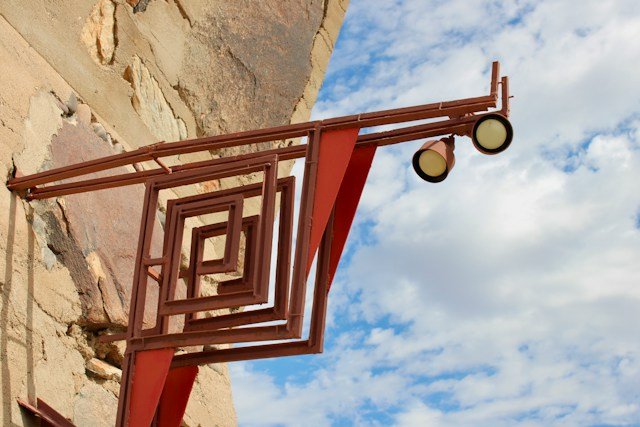
Powder-coated mild steel is the most common material used for wall art that hangs outdoors, and the durability of the artwork hinges purely on the quality of the powder coating and whether or not the cut edges have been sealed. Unsealed cut edges start the corrosion process, rather than a cut edge in the middle of a sheet where there is complete coverage with coating. The corten steel oxidises on purpose to produce the rust-like look, it fits into modern Australian garden style very well, does not require any painting once it reaches stabilisation and has character, even if the oxidation process leaves iron-oxide stains on light-coloured pavers or rendered walls underneath. Wrought iron is denser, heavier and more structurally stiff than mild steel, retains its shape under wind pressure and has increased resistance to impact that is important for large abstract sculptures. Aluminium does not corrode, it is light, but lacks the density necessary for an outdoor piece at a distance of several meters.
Scale, Proportion, and Why This Changes How a Garden Actually Feels
A single larger piece of art will have more impact than multiple smaller pieces spaced out on the wall, a basic principle of interior design that applies equally well outside. Line width and negative space in abstracts are judged at the correct distance from which the piece is intended to be viewed; otherwise, a work of art designed for viewing from the other side of a deck will suffer from a line width and negative space appropriate only to viewing the piece at arm’s length.
Coastal Melbourne, the Peninsula, and Why Location Changes Everything
Properties within proximity of Port Phillip Bay get salty air laden with moisture that settles in the coating pores of metal and accelerates the corrosion process on any metal piece not designed for coastal locations. The combination of salt spray and strong winds on the Mornington Peninsula places stress on metal pieces not accounted for anywhere else.
Mounting Hardware Is Where Most Failures Begin
Large pieces of metal wall art require fasteners and mount hardware rated for the piece weight and lateral force exerted on the wall by southerly winds on the flat surface. Masonry fastening into rendered brick is different from coach bolts through a timber fence post; the wrong mounting hardware for the wall surface leads to loose fastening points that degrade over time. Most failed metal wall art outside does not fail due to corrosion of the metal piece.
Long-Term Care Is Less Involved Than Most Owners Expect
A quick rinse once per year to remove salt buildup and organic material followed by an examination of mounting hardware will suffice for the majority of well-made outdoor metal art. Touch-up paint applied to cut edges and damaged coating areas significantly prolongs its lifespan.